Last updated: November 4, 2026
"motorcycle Tibet ride" and "摩托进西藏" are asked quite a lot by foreign riders. Can you ride a motorcycle into Tibet? Of course, but there are hard requirements just like for cars: the Tibet Travel Permit, a full-time guide, and the itinerary filed in advance. Beyond the paperwork there are the special challenges of riding a bike on the plateau - altitude, weather, fuel, restricted areas - laid out one by one. This guide goes through the restrictions and preparation for riding a motorcycle into Tibet; plan from this and you will know where you stand.
You can enter, but you need the Tibet Travel Permit and a full-time guide
For a foreigner's vehicle to enter Tibet, whether car or motorcycle, the requirements are the same: a full-time guide for the whole trip, the itinerary filed in advance, and the Tibet Travel Permit. Documents must be submitted 1 month ahead - 10 days longer than a normal border entry (20 days normally; 1 month if the itinerary includes Tibet).
The Tibet Travel Permit is not something you arrange when you reach Lhasa; it is declared before entry. Our process writes the Tibet itinerary into the route filing and obtains the permit together with it. Without the permit, being checked inside Tibet is serious trouble, so do not skip this step.
The guide accompanying the whole trip is a rule of Tibet, not an extra charge invented by agencies. The guide fee and their food and lodging are paid by you - put this item in your budget.
Vehicle entry and the Tibet Travel Permit are both declared by a licensed travel agency; individuals cannot clear themselves. Right-hand-drive bikes are accepted like left-hand-drive with no surcharge; the temporary plate and licence are valid for 3 months, and motorcycles and cars follow the same standard.
The special challenges of riding a motorcycle into Tibet
Beyond the paperwork, what you really face riding into Tibet comes down to four things:
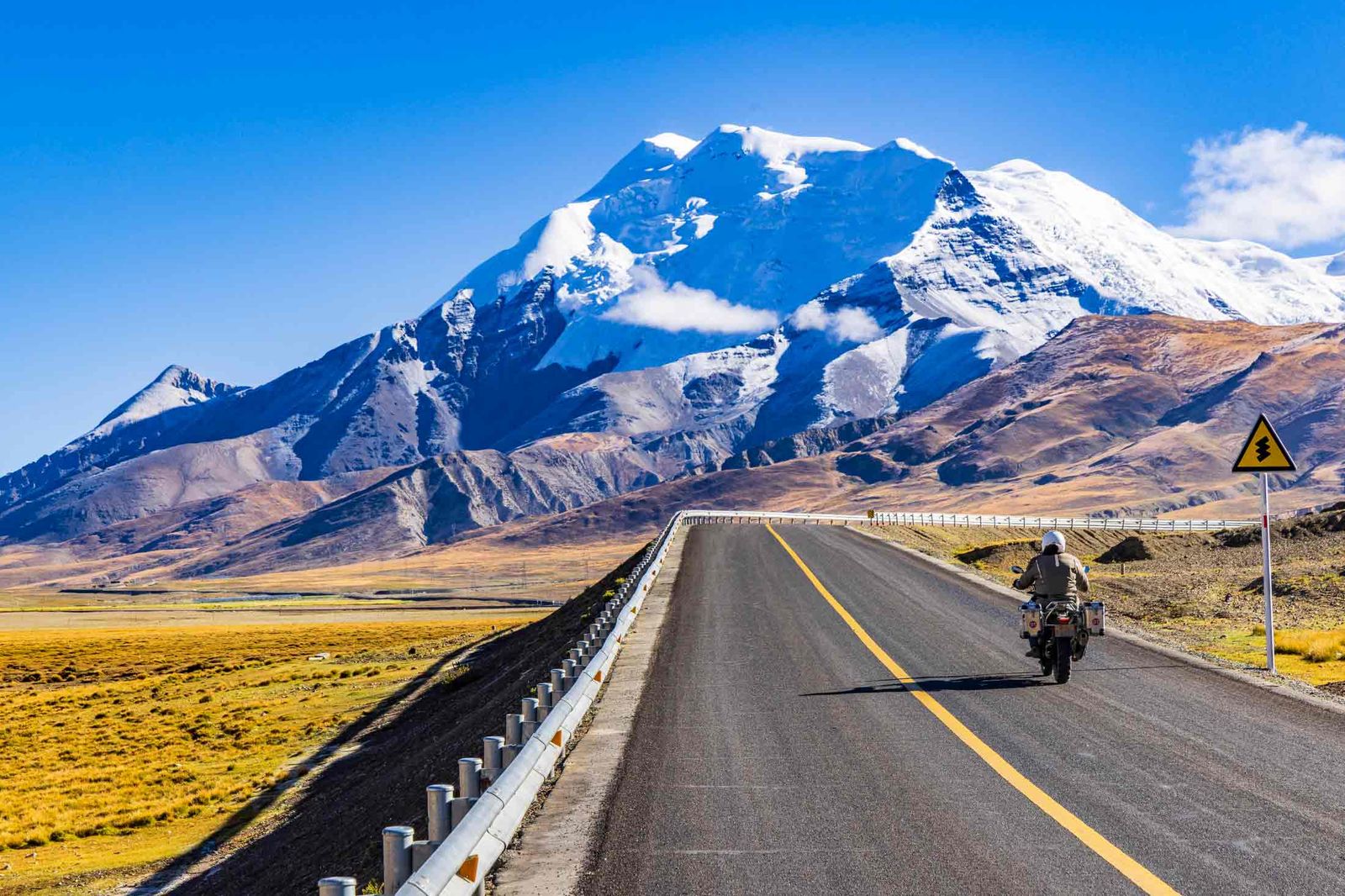
First, altitude. Passes on the Sichuan-Tibet line commonly sit at 4,000-5,000 m, and Dongda Mountain pass tops 5,000 m. People get altitude sickness, and bikes feel the plateau too - thin air cuts power, and carburetted models need the mixture adjusted. A rider adapts slower than a bike; do not push it.
Second, weather. Tibet runs four seasons in one day - clear sky in the morning, hail or snow in the afternoon. Storms arrive at the passes without warning; riding suit, waterproof gloves and warm layers are all non-negotiable, and frozen hands coming off a pass is a moment when accidents happen.
Third, fuel. Stations in Tibet are far apart, especially west of Lhasa - stretches of several hundred kilometres with no station exist. Fill up every morning and plan the next stop; do not gamble.
Fourth, rest. Plateau riding tires you far more than the plains; oxygen deficit cuts concentration. Keeping each day to 250-300 km is steady - do not try the 500 km days you do at low altitude.
Restricted-area red line: the G219 Xinjiang-Tibet line is closed
This one deserves its own section: the G219 Xinjiang-Tibet line at Dahongliutan is closed to foreigners, and the Yecheng-to-Ritu (Pangong Tso) section is also closed. The new uninhabited-area national highway in the Minfeng direction cannot be ridden by foreigners.
Foreigners going from Xinjiang to Tibet must detour back via Golmud on the Qinghai-Tibet line G109. This is a rule, not a suggestion. Plan around these sections directly; do not ride outside the filed route, because being caught drags the deposit refund into trouble.
Recommended routes: G318 Sichuan-Tibet, G109 Qinghai-Tibet and G214 Yunnan-Tibet
For entering Tibet by motorcycle, three routes are the norm:
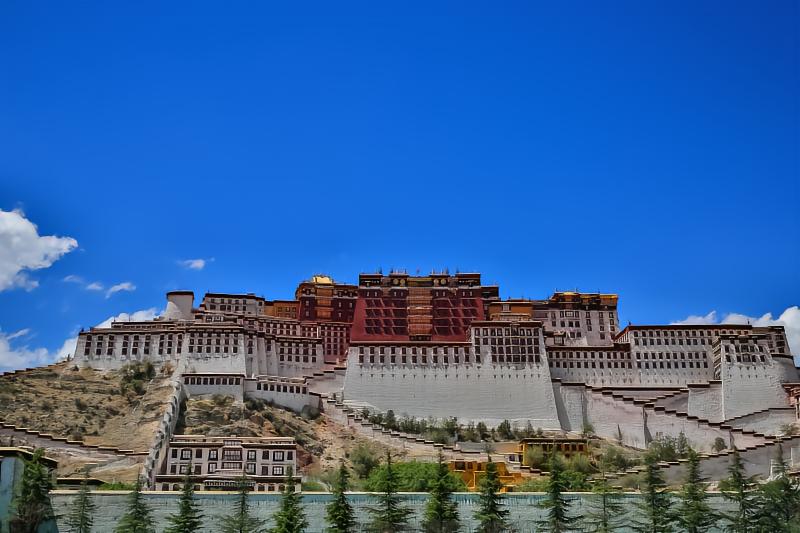
G318 Sichuan-Tibet: Chengdu to Lhasa about 2,140 km, crossing passes like Zheduo, Dongda and Selijila, scenery changing from canyon to grassland to snow mountains - the better-known entry line. Give it 8-10 days at a slow pace; rideable May-October, with July-August rain bringing landslide risk.
G109 Qinghai-Tibet: Xining to Lhasa about 1,950 km, at an overall higher altitude - straight roads, good visibility, heavy trucks. From Xinjiang into Tibet this is the only route. Rideable in winter but cold; May-October suits better.
G214 Yunnan-Tibet: Dali to Mangkam about 500 km, then north to join the Sichuan-Tibet line. Better surfaces than the Sichuan-Tibet line, mature food and lodging on the Yunnan side - ideal for riders who come in at Mohan to adapt in Yunnan first, then enter Tibet.
The connections between the three are also common: G214 north to Mangkam joins G318 into Lhasa, about 1,700 km in total, 7-10 days from Dali; in on the Sichuan-Tibet line and out on the Qinghai-Tibet line is a loop - Chengdu in, Lhasa, then Lhasa-Golmud-Xining, about 4,100 km, two weeks to 20 days. The loop suits riders with time - in on one line, out on the other, scenery not repeated. Whichever line, the Ali direction west of Lhasa (around Shiquanhe) touches border-restricted areas; whether foreigners can enter must be confirmed with your agent in advance - do not ride there and discover you cannot go on.
Season choice
May-October is the season window for entering Tibet. Specifically:
- May: snow starts to melt, passes still show snowfields, few people.
- June-August: grass green and flowers out - the peak season, but with higher landslide risk in the rains and tight lodging that needs booking ahead.
- September-October: the steadiest weather, good autumn colours, high snow-mountain visibility - the window many choose.
- Winter: high passes are ice- and snow-bound; a motorcycle is basically not suited to entering Tibet in winter - do not push it.
Beyond season, watch the weather window: on the Sichuan-Tibet line in the rains, landslides, mudslides and flooded surfaces are routine. Follow the forecast for several days before setting out and hold a day when disaster warnings appear on mountain stretches. Plateau forecasts change fast - go by the short-range forecast, not a one-week-ahead forecast, before leaving.
Coping with altitude sickness
A few practical notes on altitude sickness:
- Do not push hard entering Tibet - climb slowly and give your body 2-3 days.
- Sleep well the night before going up; no all-night riding.
- Headache and nausea are the signals - stop and rest, and dropping to lower elevation is the most effective fix.
- Serious altitude sickness is not trivial - do not tough it out; get to a clinic nearby or descend.
- A motorcycle exposes you to cold wind more than a car; head warmth matters especially, so pick a well-sealed helmet.
- Build up heart and lung fitness in the weeks before, but do not suddenly train hard right before departure; riders with chronic heart or lung conditions should consult a doctor before going to Tibet - this is not trivial.
Gear list for riding a motorcycle into Tibet
Route and season decided, pack by this list:
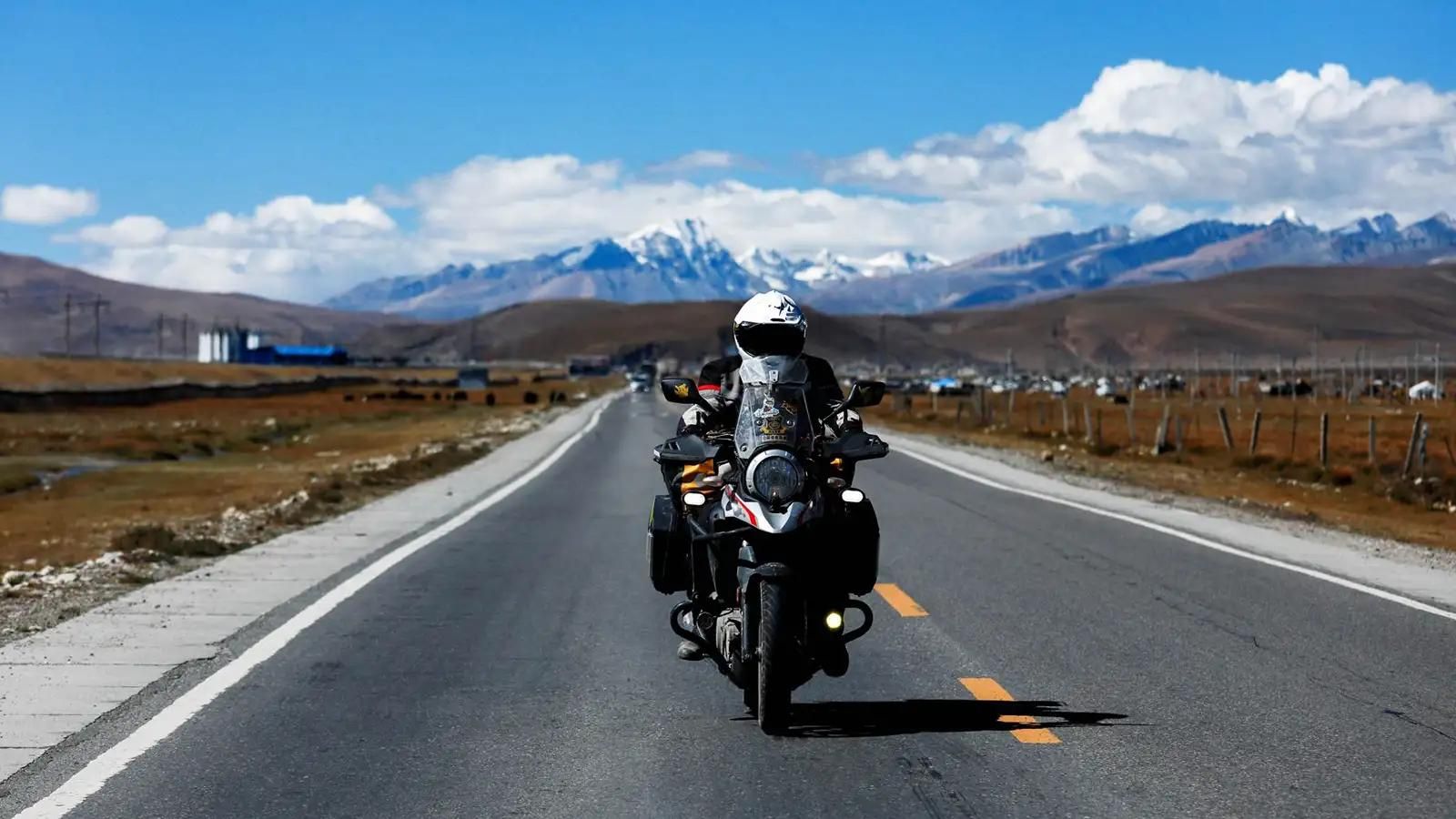
- Riding suit in three layers: breathable base, warm middle, wind- and waterproof shell.
- Two pairs of waterproof gloves to rotate - cold hands coming off a pass, swap them.
- High-top riding boots with ankle protection - Tibet's surfaces are unpredictable.
- Helmet with anti-fog visor - big temperature swings make fogging a visibility problem.
- Puncture kit, chain oil, simple tools - no repair shops in remote areas.
- Enough cash - signals are weak on remote Tibet stretches and mobile payment is not always stable.
Two honest notes on gear: do not buy cheap no-name protection for a Tibet entry - quality differences magnify at altitude, and helmet, protection and waterproofing are life-savers; and control luggage weight - a motorcycle has limited capacity, and overload hurts handling, worse at altitude where balance is more critical. Dress in layers - add and remove as needed - more practical than one heavy jacket.
How motorcycle entry to Tibet differs from car entry
The paperwork is identical; the riding experience is not:
- More noticeable power loss: smaller engines feel thin-air loss more directly than cars. Bikes under 250cc struggle on high passes - decide before you leave.
- More temperature exposure: no cabin on a bike - wind, rain and snow hit you directly, so warm gear matters far more than in a car.
- Stricter fuel planning: a small tank and short range mean planning refuels more often than a car over the same distance.
- Higher fatigue: plateau riding drains concentration, so rest more often than on the plains.
In one sentence: entering Tibet by car tests your itinerary; entering by motorcycle also tests your body and your gear.
The overall timeline for entering Tibet
Run through the timeline and you will have it clear:
- 1 month before entry: documents in, Tibet Travel Permit and Tibet itinerary filed together
- 3 days before entry: deposit arrives
- Entry day: temporary plate and licence issued at the port, half a day
- Adapting in Yunnan/Sichuan: 2-3 days, altitude rising slowly
- The Tibet ride itself: G318 about 8-10 days, G109 about 6-8 days
- Inside Tibet: full-time guide with you, riding the filed route
- Exit: leave on time, deposit back within 3-5 working days
The earlier the documents, the better - the permit and route filing take time, so do not wait until a week before departure to contact us.
Common questions
Q: Is entering Tibet more trouble on a motorcycle than in a car?
A: The paperwork is the same - permit, full-time guide, filing 1 month ahead. The difficulty is the riding itself: altitude, weather and fuel need more preparation than a car.
Q: How far ahead is the Tibet Travel Permit?
A: Documents go in 1 month ahead, and the permit is filed together with the route declaration - we handle it.
Q: How long does riding into Tibet take?
A: G318 about 8-10 days, G109 6-8 days, G214 3-5 days to Mangkam. Give yourself room; do not rush.
Q: Can I ride into Tibet in winter?
A: Not recommended. High passes are ice- and snow-bound and the risk on a bike is high - wait for spring in May.
Q: Is the Xinjiang-Tibet line really closed?
A: G219 at Dahongliutan and the Yecheng-to-Ritu section are closed to foreigners, and the Minfeng uninhabited-area highway cannot be ridden either. Xinjiang into Tibet must detour via Golmud on G109 - that is the rule.
Q: Can a small-displacement bike make it into Tibet?
A: Under 250cc you will struggle on high passes - power loss is obvious, and long climbs may drop you to third or fourth gear. It can be done, but it is tiring. Enough displacement and a healthy bike make Tibet comfortable.
Q: Do I need to change tyres for Tibet?
A: Depends on the route. The stock tyres are fine for surfaced roads; for the rainy season or planned gravel, fit all-terrain tyres. Parts of Tibet carry loose stones, and deeper tread is steadier.
Q: How is the guide fee calculated for the whole trip?
A: The guide fee and their food and lodging are paid by you, charged by the day, confirmed with the guide. It is a requirement of Tibet, not an option - leave a line in the budget.
Q: Do I need a border-area pass for Tibet?
A: For foreigners entering Tibet, what matters is the Tibet Travel Permit and the itinerary filing. Some border areas (like Everest Base Camp and the Ali direction) have border requirements - ask us in advance whether your planned route is affected, not at the checkpoint.
Q: Is motorcycle repair convenient in Lhasa?
A: Lhasa is a big city with reasonably complete motorcycle repair and parts, but small towns along the route have basic facilities. Get the bike sorted before departure - tyres, chain and brakes checked in Chengdu or Dali - and do not count on repairs along the way.
Q: Can I bring a drone into Tibet?
A: Yes, but parts of Tibet have no-fly rules - airports, military areas and border zones are off-limits. Confirm local rules before flying and stay out of trouble.
Q: Ride alone or in a group into Tibet?
A: For a first Tibet entry, ride with company - at least two bikes - so there is backup on the road. The plateau is vast and thinly populated; rescue for a solo rider is costly. Keep distance between bikes rather than riding side by side.
Q: Is there phone signal on Tibet roads?
A: Most towns and national-highway stretches have signal; remote passes and uninhabited areas drop out. Download offline maps in advance, and tell the guide or family your route and stop for each day - do not disappear.
One last note on the rhythm of entering Tibet: do not treat the Sichuan-Tibet line as an ordinary long run. It tests how the rider adapts to altitude, not how far the bike can be pushed. Take it slow, and the scenery along the way fully repays the speed you give up. On this road I have seen riders who rush and riders who look; they arrive in Lhasa in completely different states. Leave margin for both bike and body - that is the sustainable way to enter Tibet. Leave the paperwork to us and the riding to yourself - that is the most comfortable way to open a Tibet ride.
Riding a motorcycle into Tibet: the paperwork is the permit, the guide and the 1-month advance filing; the difficulty is the riding itself. Set your route and season, hand the documents and permit to us, and the rest is preparing the bike and your body. Riders planning a Tibet entry - start by adding WeChat qxzj7557, tell me the model and planned time, and I will arrange the permit, route filing and itinerary in one pass. WhatsApp, same number: +86 13759155671. Email: [email protected]. Yunnan Province International Travel Service (Group) Co., Ltd. - full outbound qualifications, with the 1.6 million RMB quality guarantee deposit lodged with the tourism authority.
Ready to plan your ride into China?
Customs declaration, temporary plate, temporary licence and guarantee - handled for you end to end. Ride across the border on arrival day and keep your energy for the road.
WeChat / WhatsApp: +86 13759155671 · Email: [email protected]
Contact Us Now