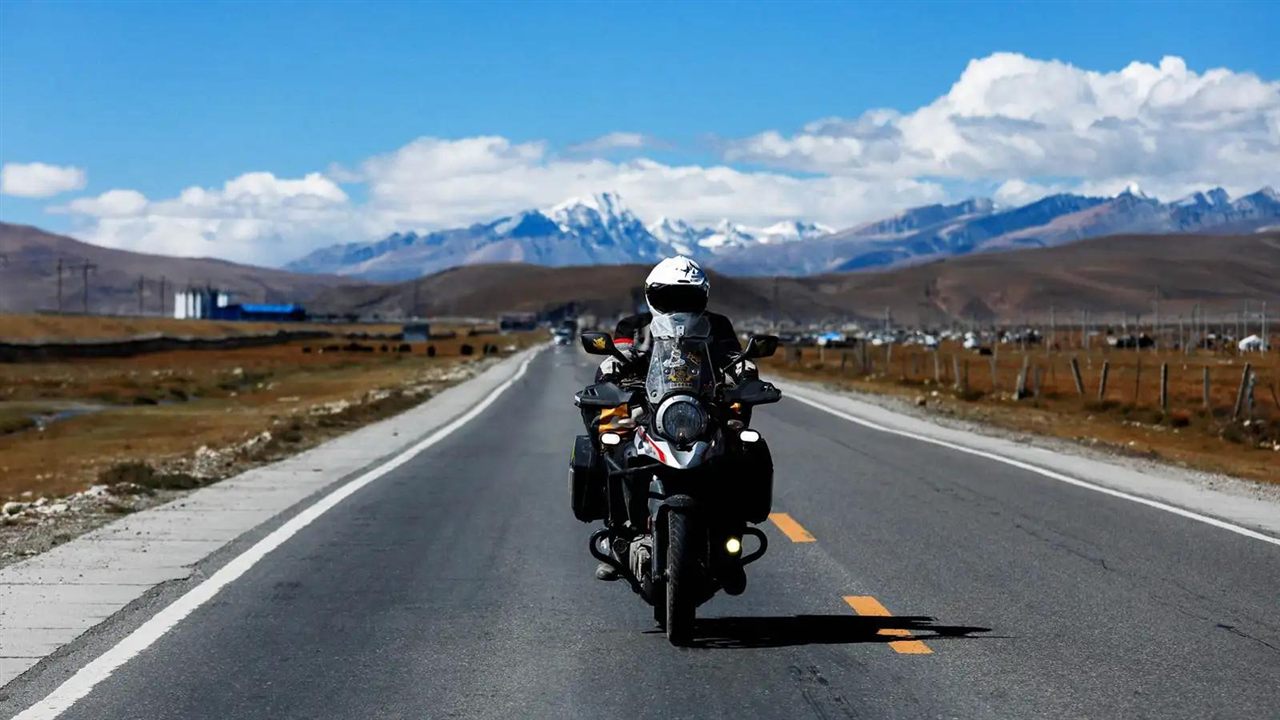
Last updated: November 14, 2026
I first saw a Nepal-registered Royal Enfield being unloaded near 吉隆 Gyirong on a bright, wind-bitten morning when the pass still looked close enough to touch. The rider was cheerful, underdressed, and carrying a folder of paperwork that was about two weeks short of what Tibet actually demands. He thought the border stamp was the hard part.
It rarely is. A motorcycle entry into China is manageable when the paperwork is filed properly, but nobody simply rides up to a port and talks their way through. A foreign vehicle must be declared through a qualified travel agency acting as guarantor. Individuals have no standing to declare and cannot clear customs on their own.
Why Gyirong changes the planning, not the entry rules
Gyirong, the China–Nepal land port, sits on the approved list alongside 磨憨 Mohan for China–Laos, 霍尔果斯 Khorgos for China–Kazakhstan, and 二连浩特 Erenhot for China–Mongolia. There are also sea-port options at Dalian, Guangzhou and Shenzhen if the bike is being shipped rather than ridden in.
Both left- and right-hand-drive vehicles are accepted at every port, with the same fees and no surcharge. That matters to riders coming from Nepal on right-hand-drive machines. China drives on the right, and the first day on a right-hand-drive bike feels odd enough at junctions, toll approaches and fuel stations without adding fatigue or altitude.
If the trip is entering from Nepal but the paperwork discussion drifts toward Mohan, that is not a mistake. Mohan is commonly used by riders travelling through Laos, and Mohan border motorcycle customs clearance follows the same guarantor principle. At Mohan the service fee is RMB 5,000–6,000 per vehicle; Laos-registered vehicles pay RMB 4,000. Motorcycles, cars and motorhomes are charged the same vehicle price.
What the agency actually handles after Gyirong
The declaration is not a stamp-and-go formality. The agency arranges the motorcycle customs declaration China paperwork, immigration formalities, route filing, the Temporary China Licence, the motorcycle temporary plate China, exit clearance and on-site port assistance.
The service fee varies by entry route. Khorgos is RMB 6,000–9,000, while a cross-through package using Khorgos in and Mohan out, or the reverse, is RMB 8,000. Erenhot is RMB 8,500. Sea entry is RMB 22,000 at Guangzhou or RMB 18,000 at Dalian, excluding ocean freight. Those sea figures look stark next to a land crossing, but they involve a different logistics chain, so I would not compare them by price alone.
The fee does not include the customs deposit, vehicle insurance, document translation, vehicle inspection, fuel, tolls, food, accommodation or a guide. Inspection is about RMB 200. The fee is also the same whether the trip lasts one month or three months; it is not a daily charge.
The deposit rule people misunderstand
With the agency guarantee, the customs deposit paid by the owner is RMB 10,000. It goes into the company’s corporate account, never a personal account, and must arrive three days before entry. If it arrives late, the declaration is cancelled and the service fee is not refunded.
After exit, the deposit is refunded by the same route within 3–5 working days, provided the vehicle exits on time, there are no outstanding traffic fines, and there are no unpaid fees or unfinished customs matters. I treat that last sentence as the rider’s responsibility, not the office’s.
Licence, plate and insurance: the three things to sort before riding
China is not party to the UN road convention and does not recognise the International Driving Permit. A rider needs a China temporary driving licence, which the agency arranges. This licence is valid nationwide. There is no separate Tibet driving licence; Tibet adds a full-time guide and a Tibet permit on top of the normal driving paperwork.
The temporary plate is valid for three months. Build the entire China motorcycle road trip around that window from the beginning, including weather delays, bike repairs and the ride-out to the planned exit port. I have seen riders treat the plateau like a faster road on the map. It is not.
Compulsory traffic insurance is mandatory because the temporary plate cannot be issued without it. Commercial third-party cover from RMB 500,000 is optional. The agency purchases insurance before entry and the client pays the actual cost.
Vehicles over six years old must pass an inspection at the vehicle management office after entry, and some ports also require a valid home-country annual inspection certificate. If that might apply to your bike, send the documents early rather than arguing about the date at the port.
Documents: ordinary trips need 20 days, Tibet needs a month
For most foreign motorcycle temporary entry China plans, documents should be ready 20 days ahead. For a Tibet itinerary, allow one month. The extra time is not bureaucracy for its own sake; the Tibet permit and guide arrangement have to match the filed route.
The document set includes:
- passport and Chinese visa;
- home driving licence and a white-background ID photo;
- vehicle licence and registration certificate;
- engine number;
- one photo each of the motorcycle’s front, rear and side.
Documents other than a Chinese licence need Chinese translation, which the agency arranges. If the motorcycle is over six years old, include the inspection certificate where required.
China offers 30-day visa-free entry. If the journey needs more time, the agency can issue an invitation letter to support a longer tourist visa application. Keep visa duration and the three-month temporary plate as separate planning points; the route should still finish within the plate’s validity.
Where a foreign-registered motorcycle can legally go
The filed vehicle can travel nationwide except where special restrictions apply. Most of China is open to a properly declared bike, but Tibet, Beijing and certain border zones need separate attention.
Tibet requires a full-time guide and a Tibet permit. Beijing requires a capital entry permit. Some border-restricted areas in Xinjiang and Gansu are off limits. The G219 Dahongliutan section is closed to foreigners, as is the Kashgar/Yecheng to Ritu, near Pangong Lake, section. The new Minfeng no-man’s-land highway is also closed to foreigners.
That kills off the romantic Xinjiang-to-Tibet shortcut many riders sketch over an evening tea. If travelling from Xinjiang to Tibet, the legal route is to detour via Golmud on G109.
The legal highways into Tibet
The legal highways into Tibet are G109, G318 and G214. That still gives a proper ride: the Golmud approach on G109, the classic Sichuan-Tibet line on G318, or the Yunnan-Tibet corridor on G214. What it does not allow is improvisation through closed border roads or no-man’s-land sections.
Riders must follow the filed route. No escort or lead vehicle is required elsewhere, but the mandatory Tibet guide remains with the Tibet portion of the trip. At checkpoints or police stops, the agency provides supporting documents remotely. Keep your phone charged, keep the paper folder dry, and answer questions plainly.
A practical Gyirong-to-Tibet itinerary shape
I would not leave Gyirong and point straight at high passes on day one. Sort the bike, licence, plate and route check first, then let the route and altitude dictate pace. A sensible plan uses legal roads, gives the guide time to meet the permit requirements, and leaves buffer days for rain, snow or a dropped bike on a gravel switchback.
Once I watched a rider on a Bhutan-registered machine, left-hand-drive configuration irrelevant on two wheels but very relevant to his junction nerves, insist he could make up a lost permit day by riding into the evening. The light went cold, the tarmac glistened, and a checkpoint queue quietly proved him wrong. The fix was not charm; it was the agency confirming the filed paperwork remotely and the guide keeping the Tibet segment intact. His mistake was treating permits as a departure-day issue rather than the frame of the whole route.
Ports are not open 24 hours, either. That sounds obvious until a rider arrives late, bank transfer still pending, and remembers the deposit deadline.
Before you commit
For a Gyirong entry with Tibet in the plan, start with the route, not the bike’s luggage layout. Confirm the entry and exit ports, the three-month plate window, the Tibet permit, the full-time guide, the RMB 10,000 customs deposit and the document deadline. Then decide whether G109, G318 or G214 fits the riding you actually want.
Yunnan Province International Travel Agency (Group) Co., Ltd. is qualified to act as guarantor, supported by a RMB 1.6 million tourism quality deposit; qualification requires that deposit plus three years of operation. Contact Zara on WeChat/WhatsApp at +86 13759155671, WeChat ID qxzj7557, or email [email protected].
Send the paperwork a month early, pay the deposit into the corporate account in time, and do not build the ride around closed roads. Tibet is worth the patience when the bike is legal, the permits match the route, and you are not arguing with a checkpoint in freezing rain.
Zara
Yunnan Province International Travel Agency (Group) Co., Ltd
WeChat/WhatsApp: +86 13759155671
WeChat ID: qxzj7557
Email: [email protected]