Last updated: November 11, 2026
Few countries pack as much variety into a single ride as China, where a few days on the bike can carry you from subtropical greenery into open grassland, desert and then high plateau. The landscape is not just a backdrop on a China motorcycle road trip; it dictates the roads, the weather, the pace and even the way the bike performs, and for many riders the changing terrain is the reason the journey stays fresh across thousands of kilometres. As a foreign rider bringing my own machine across these different worlds, I learned to expect each new region to ask for a slightly different style of riding, and to plan around what the ground was doing.
Karst hills and the wet south-west
The south-western provinces greet a rider with karst peaks, rivers and lush green valleys, often on winding roads that climb and dip through the scenery. The terrain is beautiful but damp, with frequent tunnels cut through the rock and surfaces that can stay wet in the shade, so the riding rewards smooth inputs and good visibility gear. This is a gentle introduction to China's mountains, with constant views and relatively moderate altitude, and it is where many riders first fall for the country's touring.
Rice terraces and farmland valleys
Across the rural provinces the roads run through terraced hillsides and broad farm valleys, where the land changes colour with the farming seasons and villages sit among the fields. The terrain is rolling rather than severe, which makes for relaxed mileage and frequent stops for photographs. The main riding consideration is the farm traffic and the occasional narrow village road, rather than the gradient itself. These stretches are where the daily rhythm of the trip feels particularly peaceful.
Grasslands and the northern steppe
Further north and west the farmland gives way to open grassland, where the roads straighten and run to a horizon under enormous skies, and the wind becomes the main factor rather than the bends. The riding is fast and exposed, with long distances between settlements and sudden weather, so fuel and warm layers matter more than cornering technique. A rider crossing the steppe has to plan the gaps and respect the crosswinds, but the sense of space is unlike anything in the crowded east.
Desert and arid basins
The western deserts bring their own conditions, with hot days, cold nights, sand on the road and the possibility of dust storms, and the roads stretch across arid basins between distant mountain rims. The bike works hard in the heat and the rider needs steady hydration and protection from the sun, while loose sand at the edge of the tarmac calls for a calm line. On a China motorcycle road trip these desert crossings are among the really dramatic, but they demand preparation rather than improvisation.
High plateaus and the Tibetan world
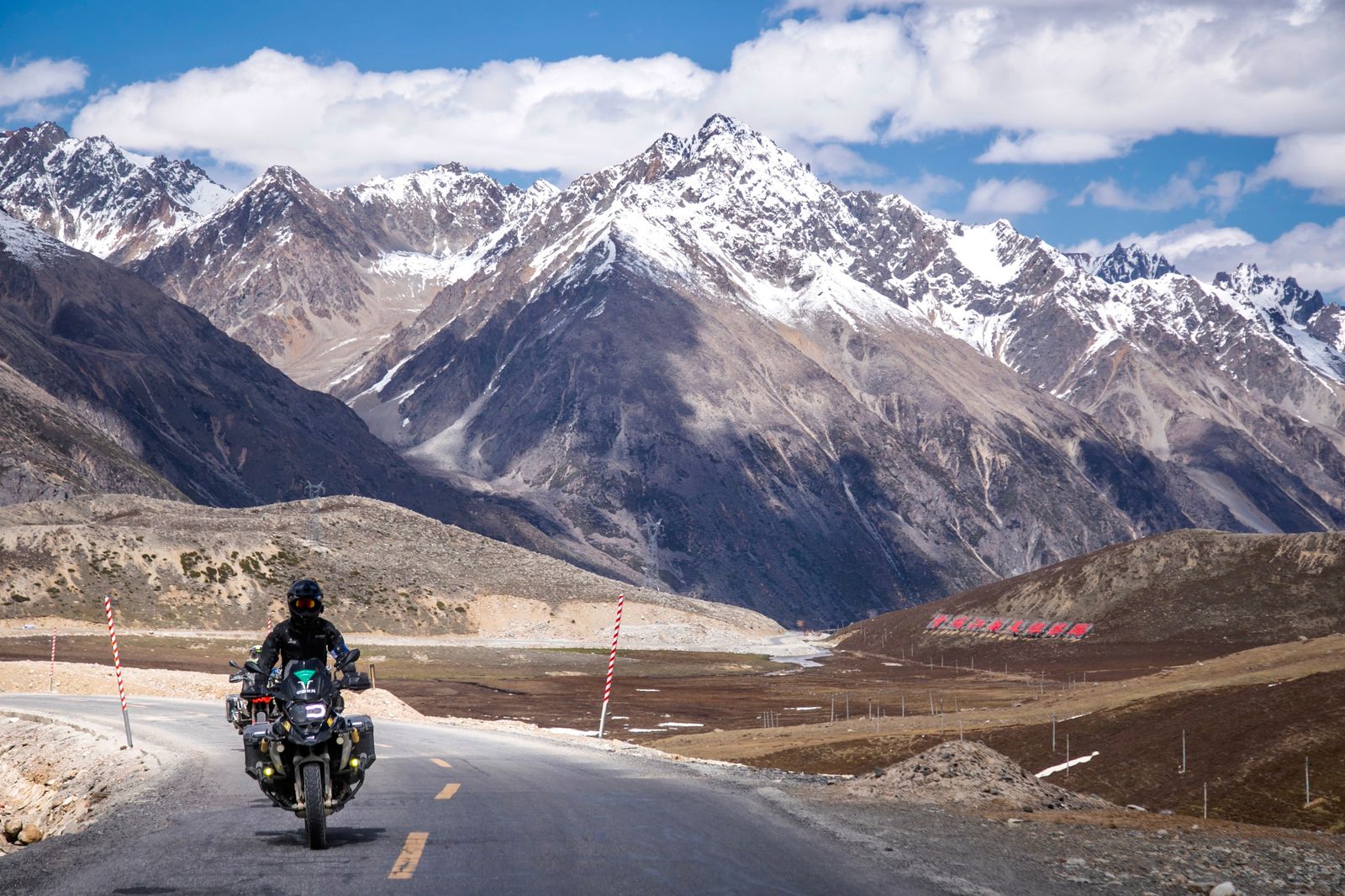
The high plateau is the terrain that changes the rider as much as the riding, with thin air, vast open views and roads that climb to serious altitude. The bike loses a little power in the thin air and the body needs time to adjust, so the pace naturally slows and rest days become important. Routes here require the correct permits and a planned approach, and the rewards are huge skies, lakes and snow peaks that no lower region can match. It is a different kind of riding, patient and measured rather than energetic.
Mountain ranges and the great passes
Between these regions lie the ranges, crossed by long climbs, hairpin stacks and high passes where the weather can turn in minutes. Each pass is a small event, with the temperature dropping at the top and the descent asking for controlled braking and a tidy line. I watch the warning signs and the cloud building, and I am happy to wait out a storm rather than tackle a pass in poor visibility. The ranges deliver the truly exhilarating roads of the trip, but they reward respect.
How terrain changes the bike and the plan
The machine responds differently in each world: heat and long straights test cooling and fuel range, altitude trims power, damp valleys test tyres and sand asks for smooth inputs. I adjust the daily distance to the terrain rather than holding a fixed target, allowing slower days on the plateau and longer runs across the open grassland. Matching the plan to the ground keeps the trip comfortable and the bike reliable, instead of forcing one style onto every landscape.
Planning a route around the scenery
The reward of understanding the terrain is that a route can be built to experience several of these worlds in one journey while giving the body time to adapt at altitude and the bike time to be checked. If you tell me how much time you have and the landscapes you want to see, I can shape a route that links them with realistic distances and the right permits, so your China motorcycle road trip gives you the full range of the country's scenery without the terrain catching you unprepared.
I plan the route around the landscapes as much as the destinations, choosing which worlds I want to cross and giving each one enough time. There is no point rushing the plateau to reach a town when the plateau itself is the reason for the ride, and the same is true of the karst valleys, the grasslands and the desert crossings, each asking for its own pace and preparation. I adjust the daily miles to the ground, expect the bike to feel different in heat and thin air, and keep the gear and permits suited to the region rather than carrying one plan for everything. A rider who lets the terrain lead the schedule sees the country properly and arrives settled rather than shaken. That responsiveness to the landscape is what turns a long ride into a genuine China motorcycle road trip.
Ready to plan your ride into China?
Customs declaration, temporary plate, temporary licence and guarantee - handled for you end to end. Ride across the border on arrival day and keep your energy for the road.
WeChat / WhatsApp: +86 13759155671 · Email: [email protected]
Contact Us Now